Defects are part of every major plant engineering project. The decisive factor is not whether they occur - but how professionally defect management is organized in project management.
This is precisely where it is decided whether projects remain controllable or gradually lose time, money and trust.
A practical comparison impressively shows how big the difference between classic and digital defect management really is.
Defect managementin project management - why the process is crucial
Many parties come together in plant construction: clients, suppliers, construction site teams, planners and project managers.
When defects occur, information must flowquickly, clearly and comprehensibly.
In reality, this often fails due to
-
media breaks (paper, Excel, email)
-
multiple data entry
-
a lack of real-time transparency
-
unclear responsibilities
The result: delays, misunderstandings and unnecessary costs.
Practical example: Defect management without digital consistency
This is what the classic defect management process without digital project management often looks like:
Typical problems with this approach
-
Repeated transmission of the same information
-
High manual effort
-
Time delays due to email communication
-
No central, up-to-date database
-
High need for coordination due to lack of transparency
In short: the process thrives on improvisation - not control.
Practical example: digital defect management with project twins
Digital project management and a digital project twin fundamentally change the process.
It is not the plant that is digitally mapped - but the project status in real time.
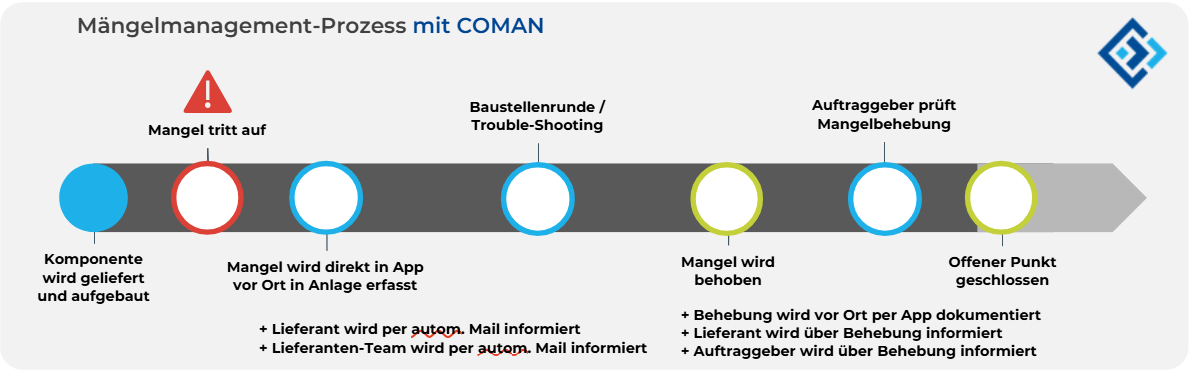
This is what defect management with COMAN looks like:
What changes as a result