Anyone who works on construction sites every day knows that construction sites are dynamic environments.
New tasks arise every day, processes shift and different trades have to be coordinated.
In complex construction and plant projects in particular, things can quickly become confusing - especially when information is stored in different places and the current project status cannot be tracked at all times.
The consequences are often gradual: coordination takes longer, decisions are delayed and open issues are lost sight of.
This is precisely why transparency is one of the most important success factors in modern construction site management today.
If you know what is happening on the construction site at all times, you can manage projects much more efficiently.
If there is no overview delays
You think problems on construction sites are caused by big mistakes?
Wrong!
A lack of transparency in everyday life is the culprit.
Information is distributed via different channels and is therefore often incomplete or no longer up-to-date.
Defects are passed on verbally, tasks are in Excel lists and photos are on individual smartphones. Status updates are also sent by email or messenger. As a result, those involved often work with different levels of information.
This becomes particularly critical in larger projects with many trades or external service providers. It is often not clear
- which tasks are still open,
- who is currently responsible,
- which defects have already been dealt with,
- and where there is an acute need for action.
A typical practical example:
A defect on a construction site has already been photographed and forwarded internally. However, as the information has not been documented centrally, the same point is recorded again a few days later. This costs time, duplicates work and delays the project.
Control is achieved through clear
processes
Keeping a construction site under permanent control does not mean having to monitor every single step manually. Instead, it is crucial that information is available centrally and that everyone involved works with the same database.
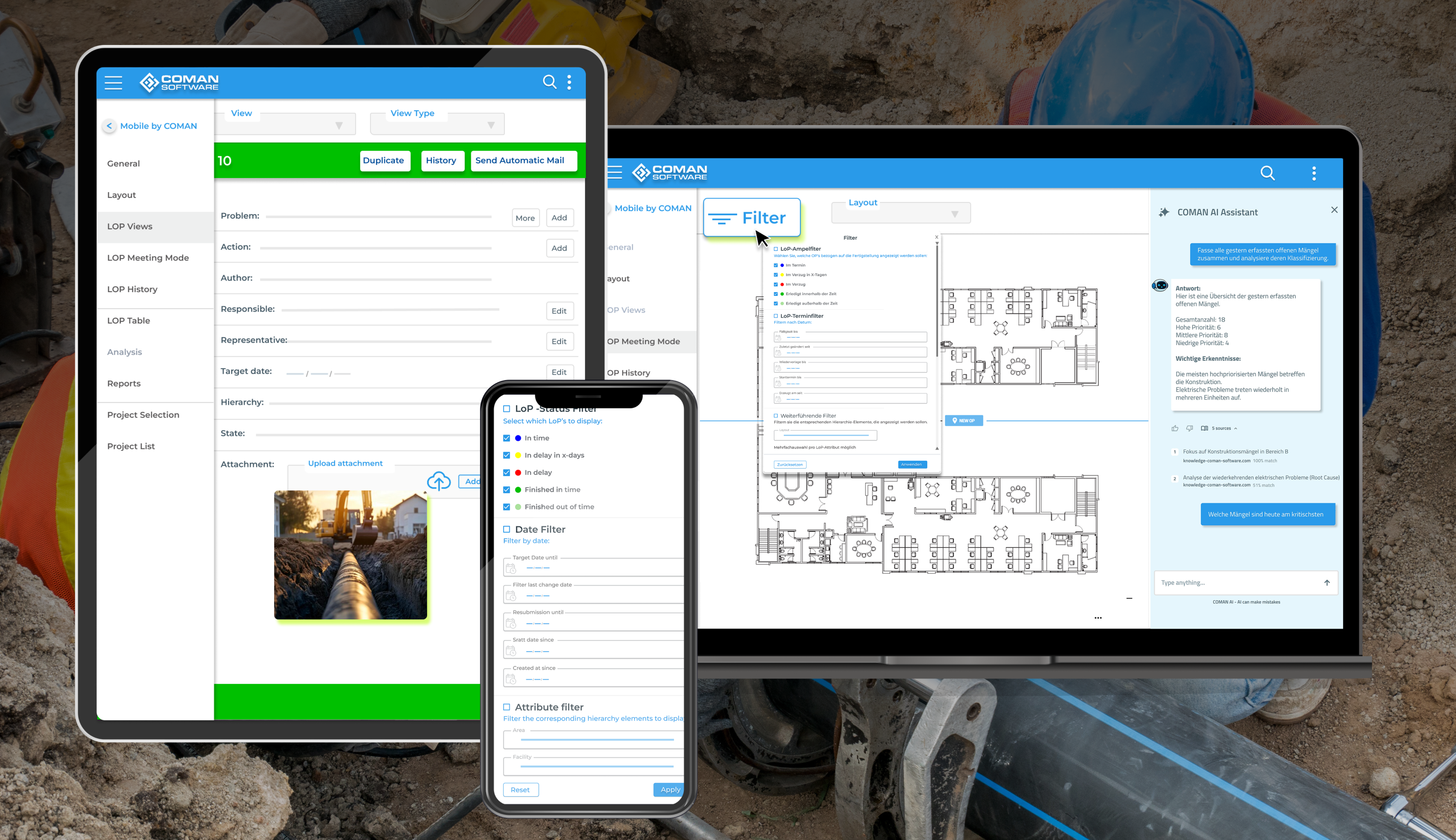
This is exactly where digital project and defect management comes in. Bundling tasks, defects and status information in one place creates transparency for the entire project team. Decisions can be made more quickly and coordination can be carried out more efficiently.
Clear processes also ensure that responsibilities are clearly defined. Open issues can be tracked and the current project status remains visible at all times.
Which software or app can I use to
track construction sites and checklists?
Many companies still manage checklists and tasks using paper lists and Excel files. This often works well enough for smaller projects - but for more complex construction sites, this method quickly reaches its limits.
Sound familiar? Then read on.
Professional construction site or defect management software helps you to record tasks centrally and track the current project status in real time.
Functions such as
mobile data recording,
photo documentation,
clear responsibilities and
transparent tracking of open issues are particularly important.
This noticeably reduces the coordination effort. Instead of collecting information from various lists or emails, teams can act directly and solve problems more quickly.
Less chaos, more transparency
The difference is enormous, especially in day-to-day project work. Instead of constantly asking about the current status, everyone involved can see immediately where action is needed and which tasks have priority.
This ensures faster coordination, clearer responsibilities and better traceability throughout the entire project. Transparency becomes a decisive advantage, especially in time-critical phases such as commissioning or project completion.
Another effect: teams work in a much more structured way. Information is no longer lost and decisions are based on up-to-date data instead of individual queries or outdated lists.
Why digital construction site
management is becoming increasingly
important
Construction and plant projects are becoming increasingly complex. At the same time, the requirements for documentation, quality assurance and adherence to deadlines are increasing. Traditional working methods with Excel lists and individual agreements are increasingly no longer sufficient.
Companies need solutions that make information available in real time and improve team networking. Digital platforms create precisely this basis and help to manage projects in a more structured, transparent and efficient way.
Those who rely on digital construction site management at an early stage reduce unnecessary coordination, improve collaboration and create more stable processes in the long term.
Conclusion: an overview is no coincidence
Having a construction site "under control" does not depend on individual people or spontaneous coordination. Clear processes, transparent information and a central overview of tasks, defects and project progress are crucial.
With a structured digital way of working, project teams can keep an eye on the current status at all times and create the basis for more efficient construction and plant projects.